Established 2000 12,000+ inspections

Experienced eyes before you close.

713-647-6090

Houston mold testing, assessment & indoor air quality

A clearer property record when moisture or indoor-air questions matter.

Inspection Pros brings 25+ years of Houston-area inspection experience to focused Mold & IAQ questions. Start with the condition, the property history, and the decision in front of you—then build the right scope around it.

START WITH
THE QUESTION

When a focused assessment can help

Know what raised the question before you decide what to test.

Good assessments do not begin with a generic sample package. They begin with the property event, location, odor, visible condition, or transaction question that needs a better record.

Recognizable property triggers

Four reasons to ask for more information.

These are practical starting points—not a diagnosis and not an automatic reason to sample. They help you explain the property question when requesting service.

01

A water or moisture history

A plumbing leak, roof leak, overflow, water event, recurring condensation, or a repaired area that still leaves a property question.

02

An odor or dampness concern

A persistent musty odor, a room that remains damp, or recurring moisture on windows, walls, pipes, or nearby materials.

03

Visible or inspection-related clues

Water staining, material changes, discoloration, a suspected visible condition, or a moisture concern identified during a standard home inspection.

04

A transaction or repair decision

A pre-purchase concern, seller repair history, a pre-listing question, or a need to document conditions before deciding who should address the next step.

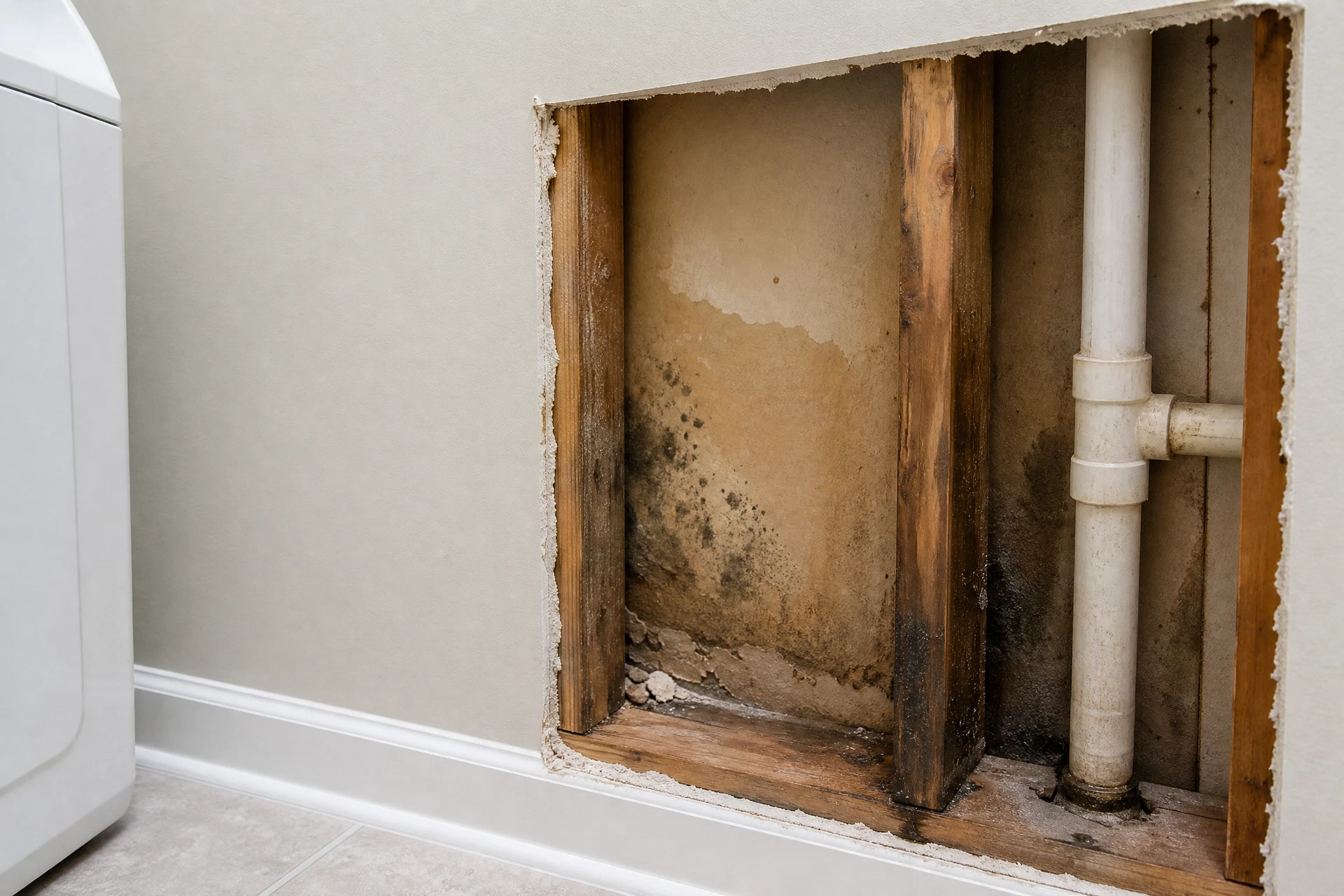
Moisture damage behind an interior wall near plumbing
Mold can be hidden in inconspicuous places.

When a condition may be out of sight

Moisture can travel beyond the place where it first becomes visible.

A stain, odor, repair, or leak history may point to a specific property question. It does not automatically show the full pathway, the condition inside a wall, or the right next step. That is why the location, history, accessible materials, and agreed scope matter before anyone treats a sample result as the whole answer.

Under sinks & behind plumbing

Slow leaks, overflows, and moisture around penetrations can leave a history inside cabinetry, wall cavities, or adjacent finishes.

Around windows & exterior openings

Past intrusion can affect nearby materials even after the exterior surface, trim, or paint has been repaired.

Near HVAC equipment & returns

Condensate, drainage, humidity, or airflow questions need the specific location and history documented—not a generic whole-home assumption.

At ceilings, attics & repaired areas

Roof leaks, prior water events, and repaired staining can create a question about the condition that remains accessible at the time of assessment.


The assessment path

A focused process from question to next step.

Each step keeps the assessment tied to the property and your decision rather than treating a sample result as a complete answer on its own.

01

Start with the decision you need to make

Tell us what prompted the question: a recent event, a location in the home, a report observation, a repair history, or a transaction concern.

02

Review the accessible property context

The assessment begins with accessible observations and the moisture-related context available at the time of the visit. That context matters as much as the sample count.

03

Choose the right sample plan when it is useful

Sample type, count, and location are selected around the property question. Sampling is not automatically the right answer to every visible condition or moisture history.

04

Document locations, scope, and limitations

The report identifies what was evaluated, the selected locations, applicable results, and the limitations that define the assessment record.

05

Use the record to choose a next conversation

The documented record can support a repair, remediation, further-evaluation, seller, or transaction conversation without claiming an outcome the assessment cannot guarantee.

Sample planning & starting prices

Use the right sample type and count for the question.

Air and surface samples answer different property questions. We explain the planning reference before you schedule, then confirm the actual scope for the property.

Review complete pricing guidance

Starting price with a basic home inspection
Mold & IAQ assessment starts at $395 when performed with a basic home inspection. That starting price covers three samples.

Standalone starting price
A standalone Mold & IAQ assessment starts at $495 and also covers three samples. Additional samples are $75 each when a broader property-specific scope is appropriate.

Air-sample reference
One exterior baseline sample is required when air sampling is selected. We recommend one interior air sample per 1,000 square feet; a 4,000-square-foot home would typically use four interior air samples plus one exterior baseline: five total samples.

Surface-sample reference
Where a focused surface question is appropriate, the three-sample starting scope may instead use three swab or tape-lift samples. The selected locations are tied to the condition being documented.

What each sample can help document

A sample result is part of the record, not the whole answer.

The useful question is specific: what condition are we documenting, where is it located, and what does the selected sample type actually represent?

01

An air sample is a selected-location snapshot

An air sample is collected for a defined indoor-air question at a selected location. It is interpreted with the exterior baseline, accessible observations, moisture history, scope, and stated limitations—not as an inspection of every room or concealed space.

02

The exterior baseline is the comparison point

When air sampling is selected, one exterior baseline sample is required. It establishes the outdoor reference that belongs with the interior sample results for that assessment.

03

A swab or tape-lift sample documents a surface

A surface sample can document a selected material or visible condition. It is a focused surface record; it does not describe the air in the whole home or every unseen location.

04

The property determines the sample plan

The plan begins with the question, location, history, and accessible conditions. More samples are not a default upsell—they are considered only when a broader record is useful for the property decision.

Understanding mold names in a report

A mold type needs location and property context.

Laboratory terminology can be useful, but a name, color, or count is not a stand-alone property conclusion. The record connects the selected sample to the specific place and question that led to the assessment.

01

Mold names are laboratory references

A lab result may identify a category or genus, such as Cladosporium or an Aspergillus/Penicillium-type grouping. That name helps describe the selected sample; it does not identify every source, room, or concealed area.

02

The exterior baseline matters

When air sampling is selected, the required exterior baseline is part of the context. Interior results are considered with that comparison, the selected location, accessible observations, moisture history, and report limitations.

03

“Black mold” is not a property assessment

Color or a single label is not a shortcut to the extent of a condition, an occupant-health conclusion, or a prescribed repair. The assessment stays focused on the documented property question.

04

A sample does not map the entire home

Air and surface samples document selected locations. They do not prove the absence or extent of conditions behind every wall, below every floor, or in areas outside the approved scope.

Before the visit

Bring the history that gives the property context.

A little preparation helps define the assessment question, protects time on site, and makes the resulting report more useful for the next conversation.

01

State the property question

Share the property address, the location of concern, and whether the question is part of a purchase, sale, repair, or general property decision.

02

Collect available history

Gather any useful history: approximate timing of a leak or water event, prior repair invoices, remediation paperwork, photographs, and prior inspection records.

03

Confirm access

Let the office know about access restrictions, vacant-property procedures, pets, tenant coordination, or rooms that need special access before the appointment is confirmed.

04

Keep the condition visible

Do not conceal, paint over, or remove a condition you want documented before discussing the assessment scope with our team.

Authentic specialty reportMOLD / IAQ

01 The property question

02 Accessible observations

03 Sample locations and applicable results

25-page
sample record

Look at the record before you request the service

See how the report organizes the question, scope, and next step.

View the authentic sample Mold Assessment Report to see how observations, selected locations, applicable results, and stated limitations are presented. It is an illustration of the reporting format; every property and assessment is different.

Open Mold Assessment sample report

What the report helps you use

A property record—not an unqualified conclusion.

The property question
Why the assessment was requested and the history or concern provided for the property.

Accessible observations
The conditions observed within the agreed scope at the time of the visit.

Sample locations and applicable results
The sample approach, selected locations, and applicable results when samples are part of the approved scope.

Limits and next-step context
Access, scope, and other stated limitations that keep the report useful without overstating what it can establish.

Clear professional boundaries
The assessment does not replace a general home inspection, predict every concealed condition, diagnose occupants, prescribe remediation, or promise a clearance outcome.

How the record can be used

Useful context for the person making the next decision.

The value is a clear property record that helps the right conversation happen next. It is not a prediction, a health opinion, a repair proposal, or a guaranteed transaction outcome.

01

For buyers

Connect a specific concern to the overall inspection record

If moisture history, staining, an odor, a disclosure, or a home-inspection observation raises a focused question, the assessment can document that question before the next transaction conversation.

02

For sellers

Organize the condition and repair history

A focused record can help organize what was observed, what history was available, and which next conversation may be appropriate. It does not guarantee a repair, a transaction result, or a clearance outcome.

03

For Realtors

Help clients move from uncertainty to a defined next step

A report can help the client, agent, and appropriate next professional discuss a documented property issue without turning the inspection into speculation or alarmist language.

04

For owners

Create a record before choosing the next professional

When the question involves a leak history, recurring dampness, or a visible concern, the assessment can support a more informed repair, remediation, or further-evaluation discussion.

Mold & IAQ questions

Useful answers before you schedule.

These are the questions that usually determine whether a buyer, owner, or Realtor needs a focused assessment and what the scope should address.

Read U.S. EPA mold-sampling guidance
Do I need a Mold & IAQ assessment or a standard home inspection?

A standard home inspection is the right starting point for the overall property. A Mold & IAQ assessment is useful when a specific moisture, odor, visible-condition, water-history, or indoor-air question needs more focused documentation.

Does every moisture concern require sampling?

No. The appropriate scope depends on the property condition and the decision you need to make. A visible condition or known moisture source may call for documentation and a repair conversation rather than automatic sampling.

What is the difference between air samples and swab/tape-lift samples?

Air samples are used for an indoor-air question and include a required exterior baseline reference. Swab or tape-lift samples focus on selected surfaces. The property condition and assessment question determine which option is more appropriate.

How many air samples might my home need?

One exterior baseline sample is required. We recommend one interior air sample per 1,000 square feet. For example, a 4,000-square-foot home would typically have four interior air samples plus one exterior baseline sample: five total samples. The actual scope is confirmed for the property.

What is included in the starting price?

The $395 starting price with a basic home inspection, or $495 standalone starting price, covers three samples: one exterior baseline plus two interior air samples, or three swab/tape-lift samples. Additional samples are $75 each.

Is there a pass-or-fail mold number for a home?

No. Sample results need property context, and there is no federal airborne-mold limit that makes one number a universal pass-or-fail standard. For additional homeowner education, review the U.S. EPA’s Mold Testing or Sampling guidance.

Does the assessment diagnose health concerns or guarantee clearance?

No. Inspection Pros documents the property assessment within the approved scope. The service does not diagnose occupants, provide medical advice, promise a health outcome, or guarantee environmental clearance.

What can I do with the report after the assessment?

Use the property record to guide the appropriate next conversation: a repair question, remediation discussion, further evaluation, seller-request discussion, or another transaction decision. The report documents the assessment; it does not prescribe a guaranteed result.

Houston-area coverage

Mold & IAQ assessment where your transaction takes you.

Houston and close-in neighborhoods
Houston, Rice Military, River Oaks, and Clear Lake.

West and south
Katy, Cypress, Sugar Land, and Pearland.

North and northeast
Humble, Montgomery, and Conroe.

For another Houston-area property, share the address and the Mold & IAQ question when you schedule so our team can confirm the appropriate service scope.

Start with the property question

Bring a clearer moisture or indoor-air record to the next decision.

When you schedule, share the property address, the room or area of concern, the water or repair history you know, and whether the question involves a purchase, sale, or current home. We will help confirm the appropriate scope before the appointment is final.

Schedule Online